Blog

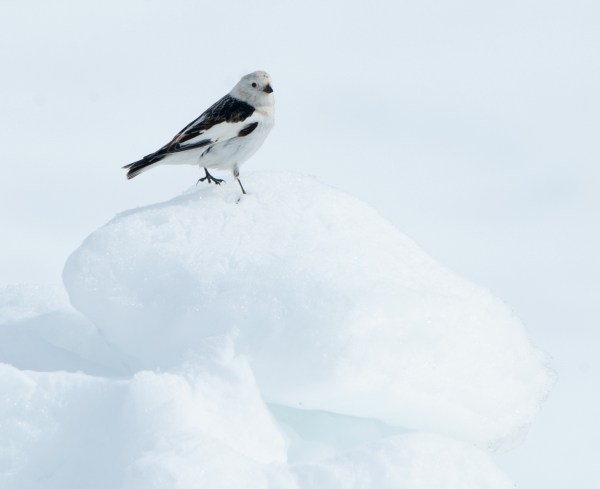
Environmental chronicle : The snow bunting, feathered flake

As every year since 2004, our team from the CNRS and the French Polar Institute Paul-Emile Victor has been on the east coast of Greenland, in Ukaleqarteq, to study the animals (end). Today, the snow bunting.

At 4 a.m. they wake me up again. I can hear their little paws drumming above my head. Although they weigh only 35 grams, they make a hell of a racket. A whole family of snow buntings is hunting for insects and spiders in the permanent Arctic summer sun. Around 4 a.m. the sun comes out from behind the mountain and warms the dark shingled roof of our Greenlandic hut.

This sudden rise in temperature animates the invertebrates, which the buntings chase frantically. Several groups of four or five youngsters are accompanied by their mothers, from whom the youngsters beg for food with loud chirps.

The young buntings were born two weeks earlier in a rock crevice, a nest carefully chosen by their parents to be out of reach of ermines and foxes. These highly secure quarters are rare, and the males return from migration as early as April to guard their chosen nest and wait for the previous year’s mate.

They then face near-winter conditions, with temperatures often close to -30°C and blizzards that completely cover the birds huddled in the wind. They move around and rest in small groups but, unlike the penguins in Antarctica, they do not huddle together to better cope with the cold: they prefer to shiver, lying in the snow or in a rocky crevice, a few dozen centimetres apart.

Incredible buntings, which alone among the passerines (1) have managed to colonise the very high latitudes in the north of the globe. They nest all along the coasts of the Arctic as far north as Greenland, thanks to an extraordinary metabolism and sometimes a little help from humanity. In the cold, the buntings come close to the houses, to take advantage of the bread crumbs but also to peck at the grasses that surround the Inuit villages.

This vegetation is fertilised by the faeces of the inhabitants and the sled dogs, which are themselves mainly fed with the products of hunting marine mammals, birds and fish. Indirectly, some snow buntings are thus saved from the polar cold by the abundant marine resources of the Arctic.

These buntings, satisfied with the service, spend the whole winter in Greenland. The others migrate from West Greenland to the Great Lakes region of North America, or from East Greenland to the northern Caspian Sea in Russia. These long-distance journeys are made at high altitude and at night, using the Earth’s magnetic field as a compass. But navigation is not without its faults and some get lost, like this beautiful male that appeared in the Chausey Islands (Normandy) in the spring of 1994, which was already calling me towards Greenland.

(1) Small birds belonging to the order Passeriformes, which includes more than half of the 10,000 bird species.

Environmental chronicle

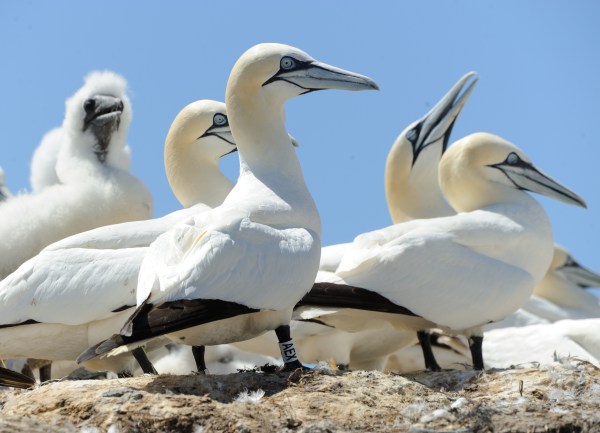
In Brittany, gannets are on the decline

September 2021: There are plans for a marine extension to the natural reserve of the Sept-Iles archipelago in Brittany. This marine extension may include a quiet zone, closed to marine traffic between April and August each year. The quiet zone will be essential for rafts of northern gannets and other seabirds, the Sept-Iles being the most important seabird breeding area in metropolitan France. Unfortunately, this plan for a quiet zone is meeting the fierce opposition of local recreational sailors, who see the plan for a marine extension to the Sept-Iles terrestrial reserve as an attempt to their “freedom”. I wrote a tribune in Libération, explaining why this marine extension and the quiet zone are essential for seabird conservation: En Bretagne, les fous de Bassan battent de l’aile.

COVID19: the anthropause will not happen

Do you remember that end-of-the-world atmosphere during the first lockdown? A large part of humanity was under house arrest, and in many places nature was reclaiming its rights. Ecologists call this strange phase of our history the ‘anthropause’, especially in reference to the collapse of air traffic in the spring of 2020: global energy consumption fell by 6% last year. Like many people, I said to myself, “this is it, the industrialised nations are finally going to change their ways of doing things, to review their relationship with nature”.

One year and four million deaths later, I am less optimistic. Of course, the wilderness will have gained some respite, but beyond all the human tragedies, the ecological balance of the pandemic will be negative. Locally, successive confinements have facilitated a relaxation of environmental standards in the name of maintaining production, and the lack of controls has encouraged fraud. Industrial agriculture, deep-sea fishing, logging and construction have gone into plundering mode, while the state, bogged down in crisis management, neglects the surveillance of protected areas and has given up on respecting the environmental code. This same state is losing sight of the ecological transition, while public opinion is ready, and is severely repressing alternative attempts. At the European level, decision-makers remain unmoved, as illustrated by the recent debates on the Common Agricultural Policy and fisheries: while the modalities of agroecology and fisheries ecology are well known and would allow for the necessary transitions towards more environmentally friendly practices, the recovery plans support ecologically and socially damaging operating modes. On a global scale, it is now clear that the pandemic will exacerbate poverty and the already scandalous inequalities between social groups and nations. It is anticipated that the crisis will push at least 150 million more people into extreme poverty and worsen the status of women, particularly in urban areas of sub-Saharan Africa and Asia.
As we sink back into a consumer frenzy in the wake of deconfinements, and as our economic systems pursue illusory and deadly growth, ecological research reminds us that everything is linked: environmental destruction, health and economic crises, and social tensions; with dizzying global geopolitical consequences.

Helping each other to the top

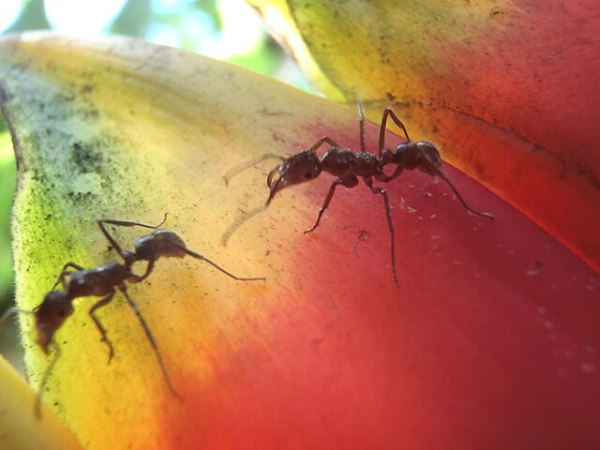
The legionary ants are making rapid progress, hunting down their prey. Cockroaches, beetles, scorpions and tarantulas are all targets. Even lizards, snakes and small birds are attacked. Captured animals are stung, cut up and carried back to the bivouac, an aggregation of ants sometimes a hundred metres away.

In the forests of Panama, a bivouac of army ants can contain two million individuals. In order to feed them, the voracious larvae and the queen they protect, an efficient supply chain must be established. Long columns of legionnaires thus roam the ground. They consist of a caste whose sole function is to transport food, at the speed of ten body lengths per second (60 km/h in a 1.7 m human). These 5 mm creatures are the fastest of all ants, but sometimes they have to cross obstacles. When a bridge is needed, the legionnaires cluster at each end of the precipice until it is filled in, in a garland of bodies. If the column has to cross a very steep area, some ants stop in the middle of the slope and dig their claws into the substrate. In this way, the individuals become an animal ladder, a scaffold that fellow ants climb at full speed.

Is this altruistic behaviour governed by a collective organisation? In order to better understand this, colleagues (1) set up a small experiment, and a lot of mathematical models. In the path of a column of army ants, they installed a board whose inclination they could vary. The agile creatures tolerated slopes five times steeper than the steepest French departmental road, but beyond this threshold they built a scaffold in 80% of cases. This allowed them to cross even a vertical wall. The researchers believe that even if the benefit of scaffolding is collective, the decision to put it up is individual: the ant fixes itself to the slope when it notices that it or its neighbours are slipping, without waiting for an order from some headquarters. The scaffold-building legionnaires would therefore not use chemical communication, as they do when they capture a large prey. In this other case, the ants emit pheromones that attract a large number of conspecifics from the bivouac in order to take advantage of an abundant resource.

It is often assumed that coordinated animal behaviour requires thought and communication. In army ants, recent research indicates that movement in the forest remains rapid and fluid due to individual reflexes in favour of a common good. This high level of responsiveness increases the resilience of the small world of social insects; its ability to overcome obstacles and upheavals.

(1) Lutz, M. J., Reid, C. R., Lustri, C. J., Kao, A. B., Garnier, S., & Couzin, I. D. (2021). Individual error correction drives responsive self-assembly of army ant scaffolds. Proceedings of the National Academy of Sciences, 118(17).

Army ants (Ch’ien Lee/Minden Pictures/Biosphoto)

Blog at WordPress.com.

Up ↑